This is a reflection on what I love about Earth’s evolutionary melting pots. For a documentation of how I made this work, check out this post.
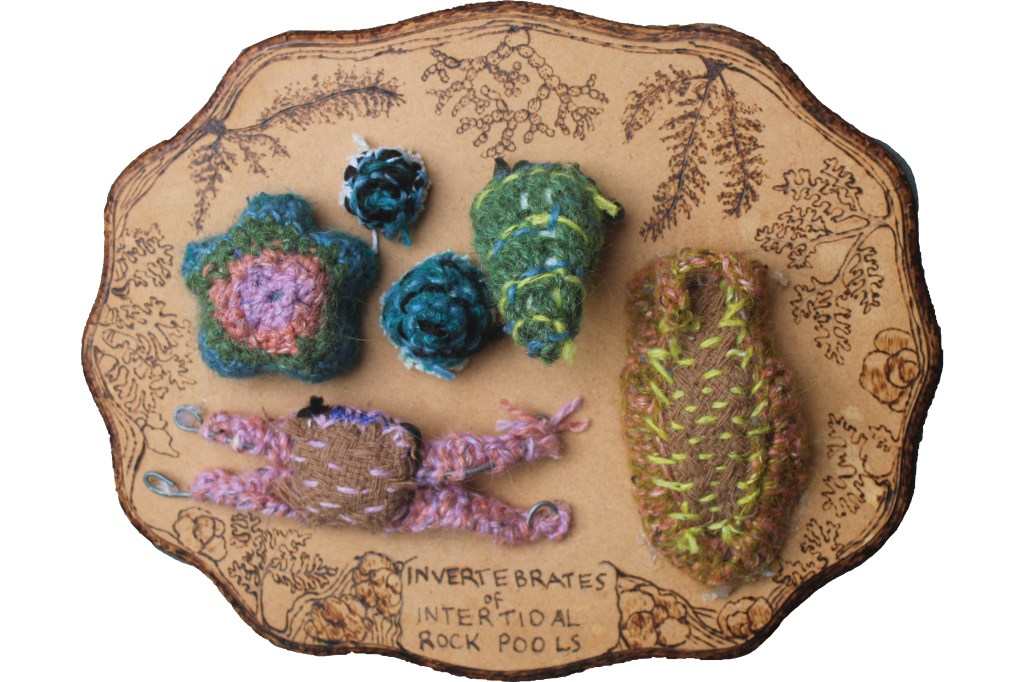
Inter x Tidal
The spaces that are sometimes on land, and sometimes in the sea are some of the most biodiverse, evolutionarily significant and interesting areas on Earth. Intertidal, which encompasses all the areas that are in between king tides, are places whose inhabitants that are determined by the moon.
Working in intertidal areas, I notice how the size of the tide waxes and wanes with the lunar cycle each month. When there is a low tide at a half moon and I have to wade into the bay, I always know that I’ll get my shorts wet as the tidal wave is at its smallest. When there is a new moon and we get to go at low tide, it’s always a good time to see animals as the water level is so low. This is also a good time to paddle up tidal rivers, as you can see all the oysters that might become a razor sharp trap at other times of day.
Every year there is an occurrence where the king tide combines with a supermoon. This is the event that determines who grows where in intertidal areas. Some plants – like seagrasses – can afford to be exposed during the king low tide, but need to be inundated with shallow water for the vast majority of the time. Other kelps and algae, as well as mangrove plants, can afford to (or need to) be exposed to air for half the day and be underwater for half the day. The king tides at high tide give the advantage to salt marshes over dune plants, as they rise and salt the Earth beneath them. The succulent, hardy salt marshes survive the inundation, while the dune plants shrivel underneath the wave.
Small areas of immense wonder
Inspecting rock pools was one of the first ways I learned how to explore and notice biodiversity. I always saw rock pools as windows into an underwater world of seaweeds, fish, snails, crab and octopus. For me, swimming in rock pools is one of the most joyous activities of my life. It feels like slipping into a waking dream. Stepping off rocks into a shallow spot, surrounded by fish and seaweeds, where I can sit still long enough for the creatures to count me as another seaform.
As I learned more about evolution and environmental science, my fascination only grew. Intertidal rock pools have been the site of transition between terrestrial and marine for over 400 million years. In rock pools, I can imagine in deep time, when some pioneering algae held onto the rock above high tide and changed the world into one with mosses, lichens and liverworts. I see how the snails and sea hares in the rock pools have cousins on land, in my garden as well as on the depths of the seafloor. In rock pools I can allow my imagination to try to expand, to marvel at how these animals evolved to inhabit so many places in air and water, and sometimes in both.
On Yuin Country, where I first learned to explore rock pools, there are also fossilised mussels, chitons and trilobites. This connection is not simply one in my imagination, but instilled into the rocks that are now exposed, growing new life and forging new evolutionary paths.
To enjoy rock pools is to value the depth and extraordinary capacity of small lives to transform this planet. I’m so lucky I get to work to encourage people to explore them.
 Eav Brennan