Almost a year ago, I went to Watershed Studios in Galway and made a comic about seagrass. This is my comic and my artist’s statement.
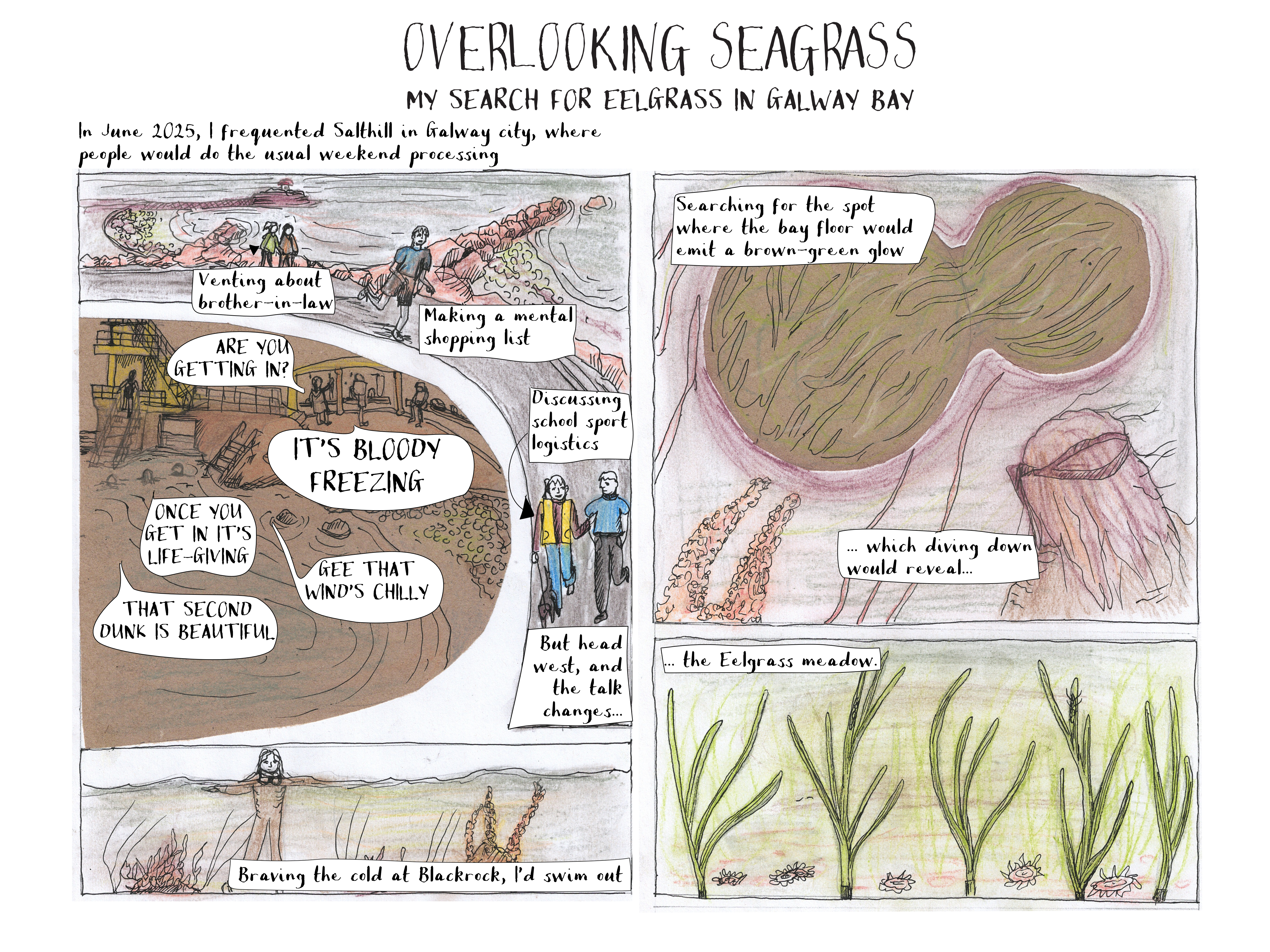
My years’ long interest in seagrass has only intensified by the privilege of spending weeks swimming off the Blackrock diving tower in Galway city, Ireland. Back home, in my day job, I teach teenagers about the significance of the seagrass in Kamay Bay on Gweagal Country (Botany Bay, Sydney). These wonderful plants sustain an enormous diversity of life even as planes coming into Sydney international airport roar overhead and huge ships move in and out of the heads. Last year, that meadow bloomed – a rare and incredible thing – and it was amazing to witness.
Because of my experience with the meadows in Sydney, I came into a month-long residency at Watershed Studios, Galway, with a readymade plan to make a comic about the restoration efforts of locals and scientists on the seagrass meadow. Before I left I studied about the European Union’s recognition of seagrass meadows as integral ecosystems for climate mitigation, biodiversity conservation and food security1 and Ireland’s management plan for protecting and restoring such important habitat2. I read guides from the USA published over twenty years ago on how to harvest and cultivate Zostera marina seeds for ecological restoration3, and researchers’ documentations on how river and ocean health together are critical for sustaining seagrass meadoews4. In the cold bay lined by Galway’s suburbs, I planned on finding the seagrass and their seeds, and illustrating the efforts of humans to expand and sustain them.
So, of course, I couldn’t find any seagrass. For over a week, I would of ride my bike over the hill to the shore, wade out with my mask, dunk my face under and try to spot anything before my brain freeze set in. I acclimatised to the water while getting to know the shrimp, crabs, wrack seaweeds and fish in the rockpools. I learned about the mounds known as drumlins – relics of the glaciers that covered the bay in past last ages – and which now are the source of the grey-beige clay that line the beaches and the cliffs that rise on headlands. All the while, I mentally prepared myself to make something else for my residency, as the seagrass might not want to be found.
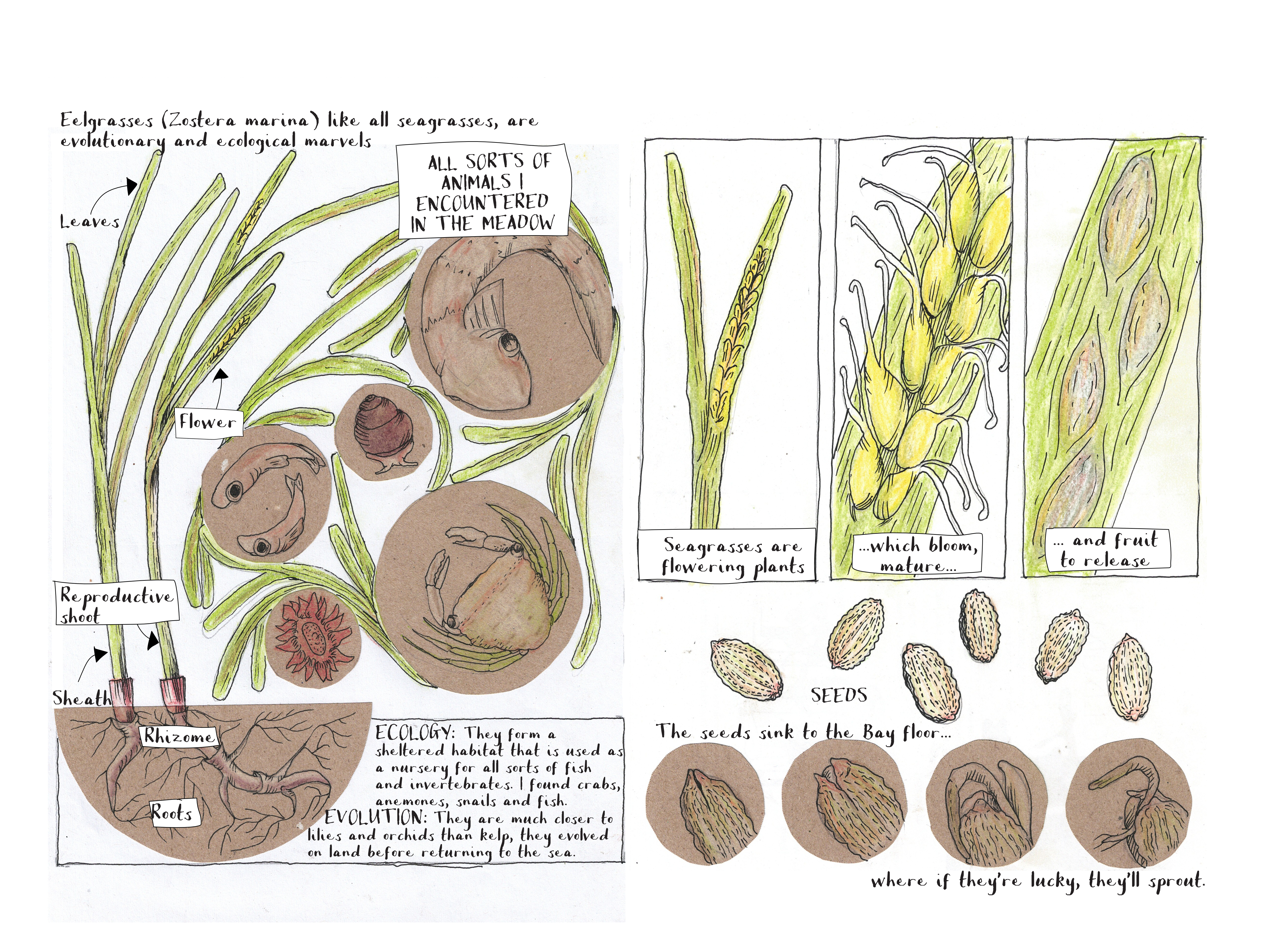
After 8 days of searching, I first saw the strange green that signals the shift from sand, clay and seaweed to seagrass looming out from underneath me. The seagrass is deeper than I expected – starting at about 2 m depth. Once I dived down for the first time, I was so elated I forgot about the cold. The seagrass meadow extended out into the bay, dotted with anemones, and – like land meadows in spring and early summer – they were blooming.
Swimming through the meadow, fish would flick out and off into the leaves. Juvenile crabs with vibrant green morphs on their legs were still and steady at the bay floor, relying on the camouflage for their safety. I would hold my breath and try to observe the flowers without damaging the meadow, and search for seeds. The flowers were just at the start of their bloom when I arrived. I watched as they sent out their pistils to collect pollen from the water column. Once I got to know the meadow, I realised how this community didn’t need my human forcing. I allowed the story of my comic to shift from one of action: Scientists and community members working the meadow to help it, to one of coexistence: Seagrass facilitating place making, full of non-humans and humans together.
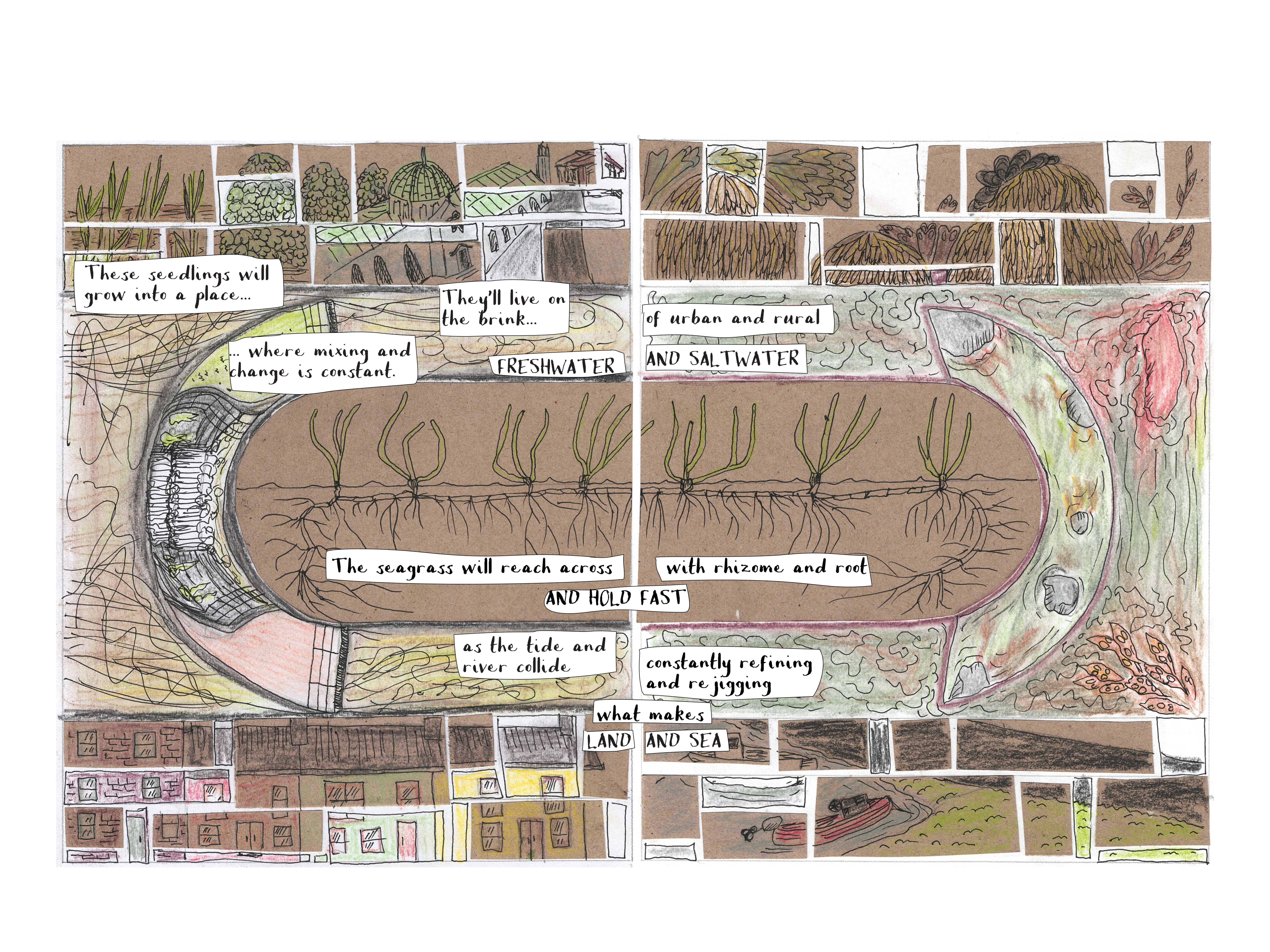
So I began to observe the humans; eavesdropping and chatting as I made my way down the promenade and used the community change rooms to haul on my wetsuit. Then, I would lower myself into the water and slowly make my way over to observe the meadow. On my way back I would ride through town, looking at the brickwork and architecture that became my grid. I wove a story from the experience I had of the seagrass which was informed by my journey to Blackrock and all the people I met there. For this comic I used recycled A4 paper and cardboard, pencils my grandparents gifted me for my tenth birthday, and a pen I found (and hopefully didn’t steal!) at Watershed studios. The lettering is digital. I used these materials to try and capture the stillness of the seagrass, and contrast it with the environment that surrounds them.
All of my drawings are based on sketches and notes; not photos or recordings. This means that none my drawings are necessarily botanically accurate, or direct quotes. It is a work of memoir and speculation, where my interpretation of a moments’ encounter with a flower as I felt my lungs start to protest, is a valid memory to inform my illustration. Where I could not encounter things first hand – like the seed germination – I had to imagine and think through how these seeds sprout from images online. The resulting comic is a story of estuarine existence, like the seagrass back home. Where humans and plants mix in with the waters and mud, and the most important beings often get washed over, unnoticed by many but crucial for their survival anyway.
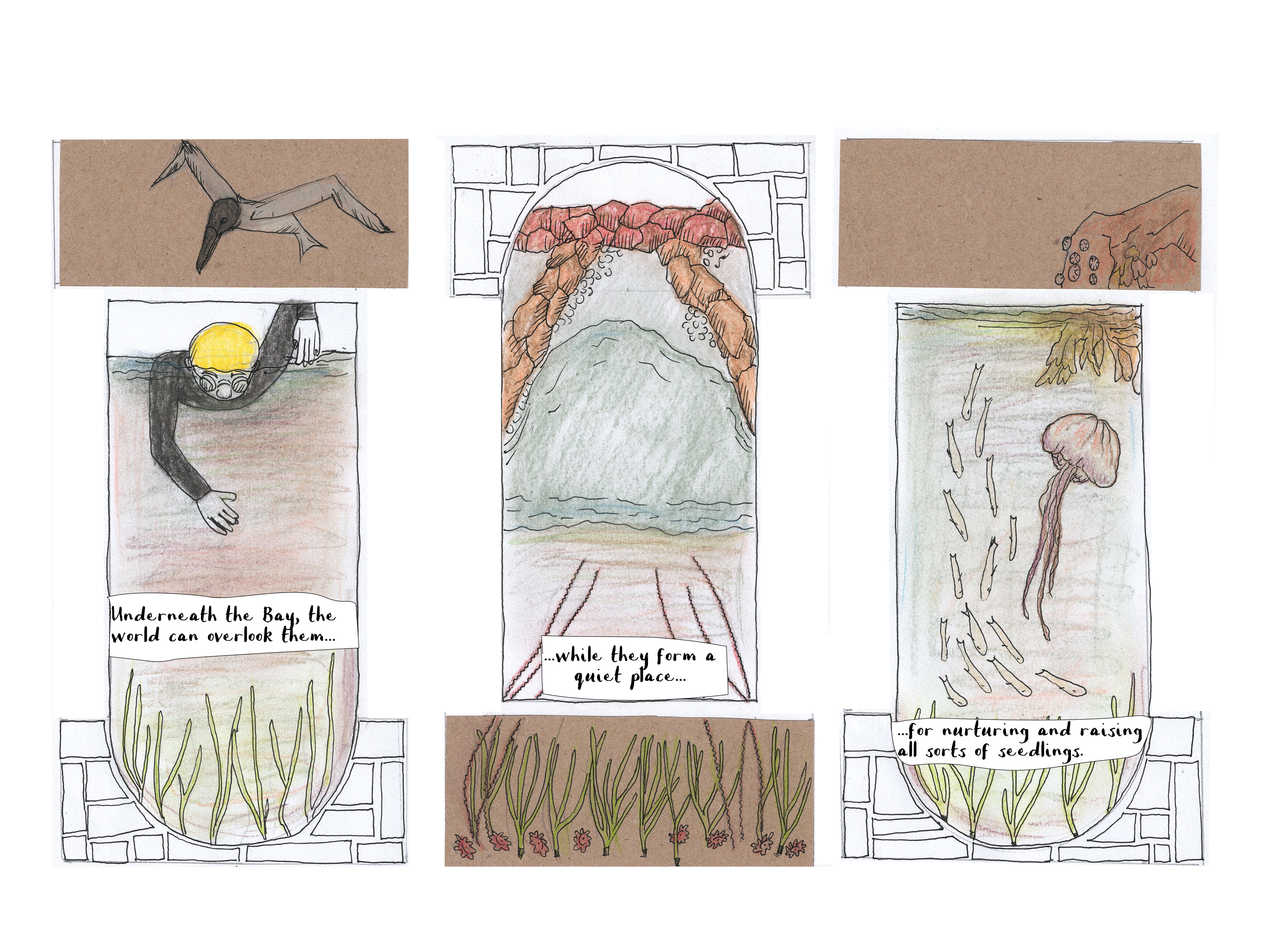
In this way, the meadows themselves function as a seed on an ecological scale. They are small, sheltered casings, full of nutrients and just enough sunlight. With a small layer of water overhead they weather the chaos of environments that mix waters and peoples. An enormous diversity of fish and invertebrates lay their eggs in seagrass, hoping that their young remain unnoticed and safe until they have been given the chance to grow. Given how many seagrass meadows and estuaries have been scoured for shipping lanes, and the proximity they share with so many of the world’s cities, I remain astonished at the capacity of the seagrass to hold such peace and potential just out of view. I hope more people notice them and value these nurseries simply for their existence – nothing more, nothing less.
References
1. NPWS, 2019. The Status of EU Protected Habitats and Species in Ireland.
Volume 1: Summary Overview. Unpublished NPWS report.
Edited by: Deirdre Lynn and Fionnuala O’Neill
2. Dale, A. L., McAllen, R. & Whelan, P., 2007, Management considerations for subtidal Zostera marina beds in Ireland. Irish Wildlife Manuals, No. 28. National Parks and Wildlife Service, Department of Environment, Heritage and Local Government, Dublin, Ireland.
3. Granger, S., M. Traber, S.W. Nixon, and R. Keyes. 2002. A practical guide
for the use of seeds in eelgrass ( Zostera marina L.) restoration. Part I.
Collection, processing, and storage. M. Schwartz (ed.)
4. Beca-Carretero, P., 2018, Irish Seagrass Ecology and Habitat Mapping in the Context of Climate Change, PhD Thesis submitted to NUI Galway, School of Natural Science, Botany and Plant Science.

